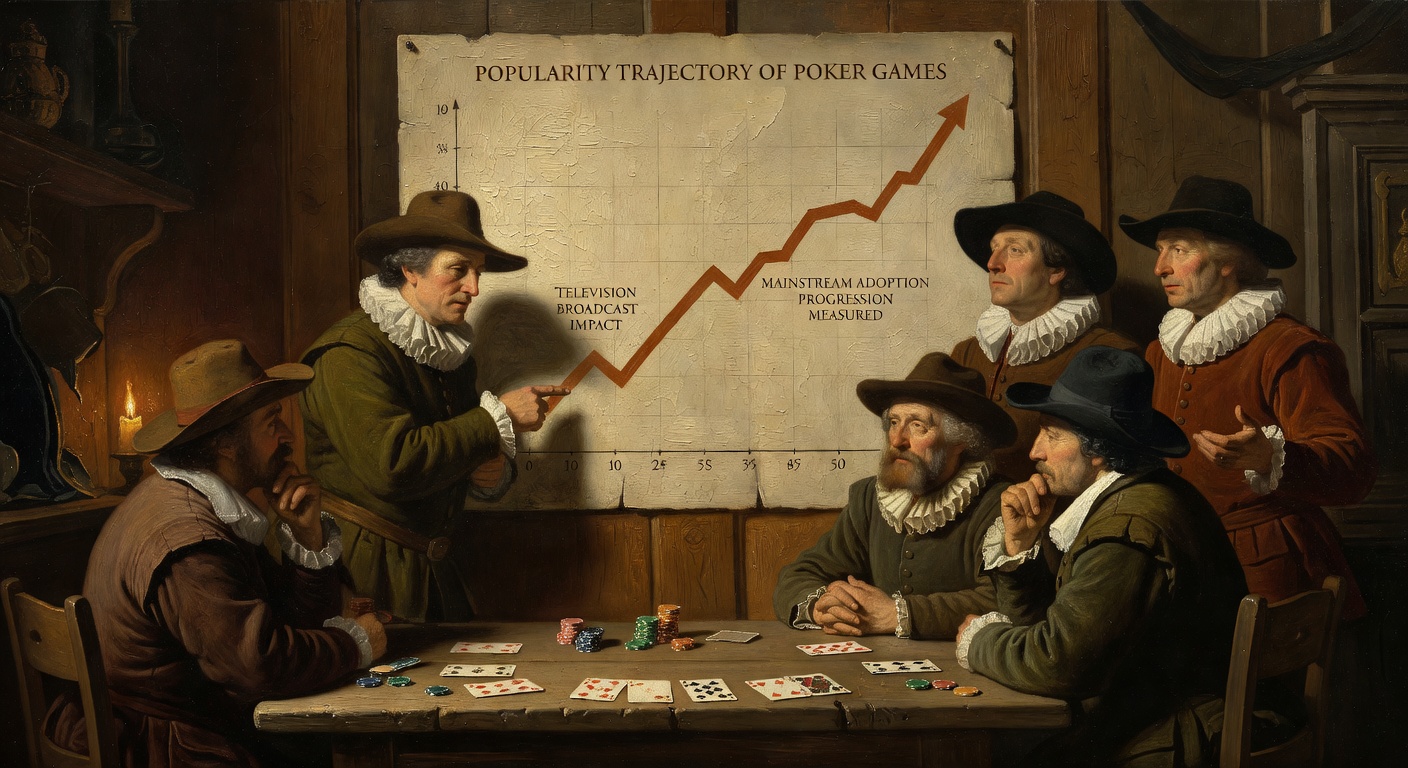
How Texas Hold'em Conquered the World of Poker
Texas Hold'em wasn't the most popular poker game until television made it so. Here's how one game became the game.
The Game Before the Game
In the 1960s and 1970s, if you walked into a poker room in Las Vegas or Los Angeles, you wouldn't find Texas Hold'em as the dominant game. You'd find seven-card stud. You'd find five-card draw. You'd find razz and other variants. Hold'em was a regional game, popular in Texas, present in Vegas, but not the default.
What changed? Television.
In 1973, the World Series of Poker began in Las Vegas. The main event was a no-limit Texas Hold'em tournament, chosen because it was the game played most in poker rooms at the time. But the format was awkward for television. Early WSOP broadcasts were boring: long waits, minimal action, cards dealt face-down.
The solution: the hole-card camera. A hidden camera showed the players' cards to the television audience. Suddenly, the game was viewable. You could see what each player held and understand their decisions. The drama, which had been invisible to outsiders, became visible.
Hold'em, shown through the hole-card camera, was perfect television. It was simple to understand (two hole cards, five community cards, best five-card hand wins). It was dramatic (one bad card could end a player). It was fast (the game resolved quickly).
Other poker variants didn't translate as cleanly to television. Seven-card stud involved too many cards. Draw poker had no visible information for the audience. Hold'em clicked.
The Propagation
Television drove adoption. Kids watching ESPN in the 1990s and 2000s saw poker. They saw Hold'em specifically. They played Hold'em with their friends. By the time they came to casinos as adults, Hold'em was the game they knew.
The "poker boom" of 2003, triggered by Chris Moneymaker (a real name, perfectly suited to poker) winning the WSOP main event, accelerated adoption. Moneymaker was an amateur who qualified through an online satellite tournament, won the main event, and became a symbol of accessibility. Everyone, suddenly, believed they could win the WSOP.
Most of those new players learned Hold'em specifically. It became not just the most popular game, but the only game most casual players knew.
Casinos, responding to demand, converted stud games to Hold'em tables. Poker rooms that had run six stud games and two Hold'em games flipped the ratio. Supply followed demand, which followed television, which followed the hole-card camera.
The Structural Advantage
Once Hold'em became the dominant game, the advantage compounded. The best players played Hold'em, because that's where the money was. Books were written about Hold'em strategy. Software analyzed Hold'em. The intellectual capital flowed toward Hold'em.
An aspiring poker player in 2010 had unlimited Hold'em instruction available: books, videos, software, live coaching. Stud instruction was thin by comparison. The economics of attention guaranteed that Hold'em would remain dominant.
The Reality Check
This isn't a story about Hold'em being the best game. It's a story about how exposure and attention create dominance.
Seven-card stud is arguably a more complex game than Hold'em. The game tree is larger. The skill differential between good and bad players is higher. But stud didn't become the television game, so it didn't become the popular game.
If the WSOP had chosen seven-card stud as its main event, and if hole-card cameras had made stud viewable, stud might be dominant today. The outcome was contingent. It happened to be Hold'em.
The Enduring Dominance
Hold'em is now so entrenched that alternatives are invisible. Most poker players under 35 don't know how to play stud. They've never encountered it. If you asked them to play a stud game, they'd need instruction.
This is network effect. Hold'em dominates because everyone plays Hold'em, so everyone learns Hold'em, so everyone plays Hold'em. The initial arbitrariness (television's choice of which game to film) calcified into permanent market structure.
It's a small example of how systems achieve lock-in through seemingly minor historical events. A different technological choice in 1973 (different camera angles, different game selection) might have produced a completely different poker landscape today.
But we got Hold'em. And Hold'em, exposed through television and hole-card cameras, became the game. Not because it's the best game, but because it was the most televised.