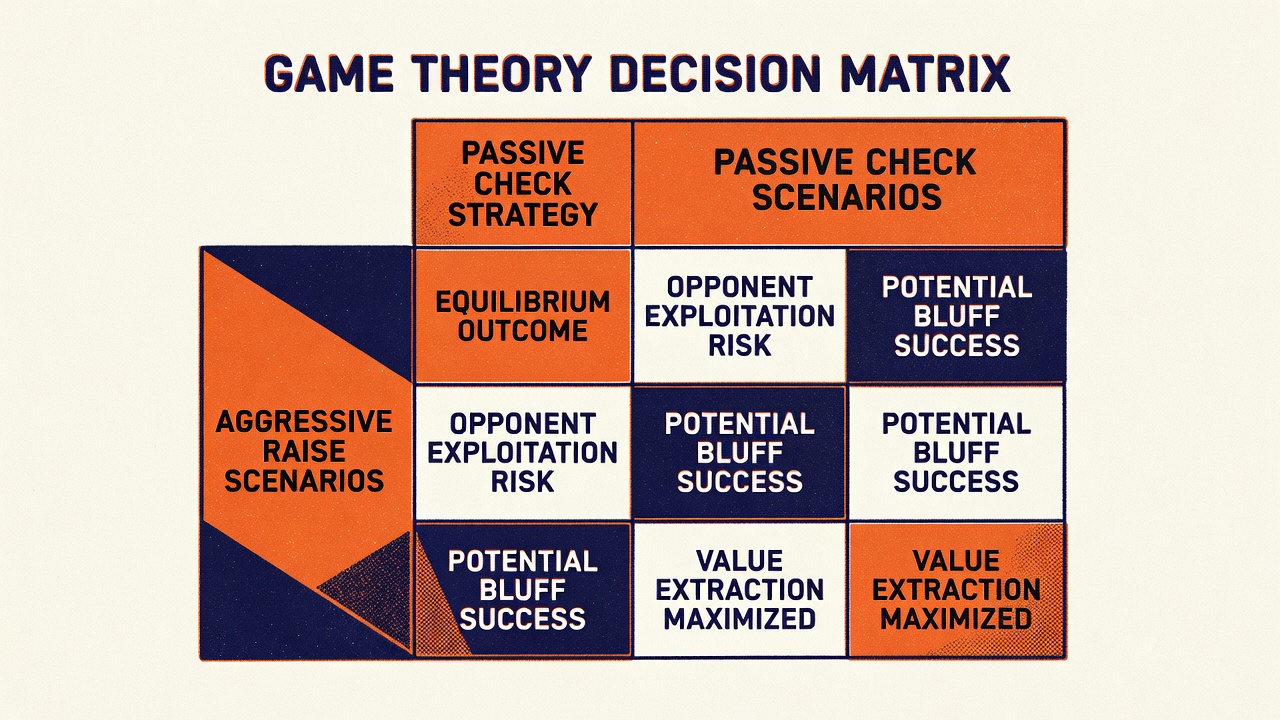
Check-Calling Strategy: When Passive Play Is Profitable
Check-calling is profitable because most poker players are overcomplicated. This is the thesis. The rest is defense.
Check-calling is profitable because most poker players are overcomplicated. This is the thesis. The rest is defense.
When the decision tree has become too elaborate, when your opponent is calculating expected value while you're working from feel, check-calling wins.
Key Points
It's not the optimal strategy.
It's a strategy that works when your opposition has gotten tangled in their own system.
Here's the structure
ou're in position. You have a hand you're not sure about. You could check-call three streets and hope something resolves. You could bet, build the pot, hope to fold better hands out. The conventional wisdom says: never check-call a hand you wouldn't bet. Make a choice. Bet or fold.
The conventional wisdom is written by people who mostly play against people who think like them.
Most poker players think poker is a game of total information. They're calculating probabilities. They're trying to be correct. This means they're exhausted and they're making mistakes. A check-call takes a weak hand and turns it into a thousand-decision point. Your opponent has to navigate all of it. Sometimes they get tired and call lighter. Sometimes they check behind when betting was right. The passive line creates more ambient decision-making.
There's a counterargument. Check-calling is weak. Good players exploit weakness. And this is true. This is obvious. But most of your opponents are not good players.
I'm not saying this is optimal. I'm saying it's profitable in conditions where humans make the decisions. It's the corollary of a simpler fact: most people are not very good at poker. They're good at thinking they're good at poker. Check-calling takes that ego and converts it to chips. The reason most poker players are overcomplicated is that poker is taught as a game of perfect information that you have to solve. Every poker book published in the last twenty years treats poker as a mathematical puzzle. You're supposed to figure out your opponent's range, calculate the pot odds, determine your equity, and make decisions based on math. This approach is correct if your opponents are also doing this. But most people aren't. Most people are playing poker from intuition, superstition, and patterns they've noticed. They're not calculating equity. They're not thinking about pot odds. They're just feeling their way through the hand. Check-calling takes this reality and exploits it. In poker, the players who are most successful against the most players are the ones who adapt. They have one default strategy, but they're willing to change it if they notice their opponents adjusting. A check-call works until someone notices you're doing it and starts value-betting with marginal hands. Then you have to switch to checking and folding. The meta-game is about staying unpredictable while maintaining an edge. The objection is obvious. If this is true, why doesn't everyone play this way? The answer is that most players don't understand this truth. They're trapped in a framework where 'optimal' means 'theoretically sound' rather than 'actually profitable.' They're playing to be right instead of playing to win. This is the difference between a skilled player and a good player. A skilled player can describe the theory. A good player can profit from reality.