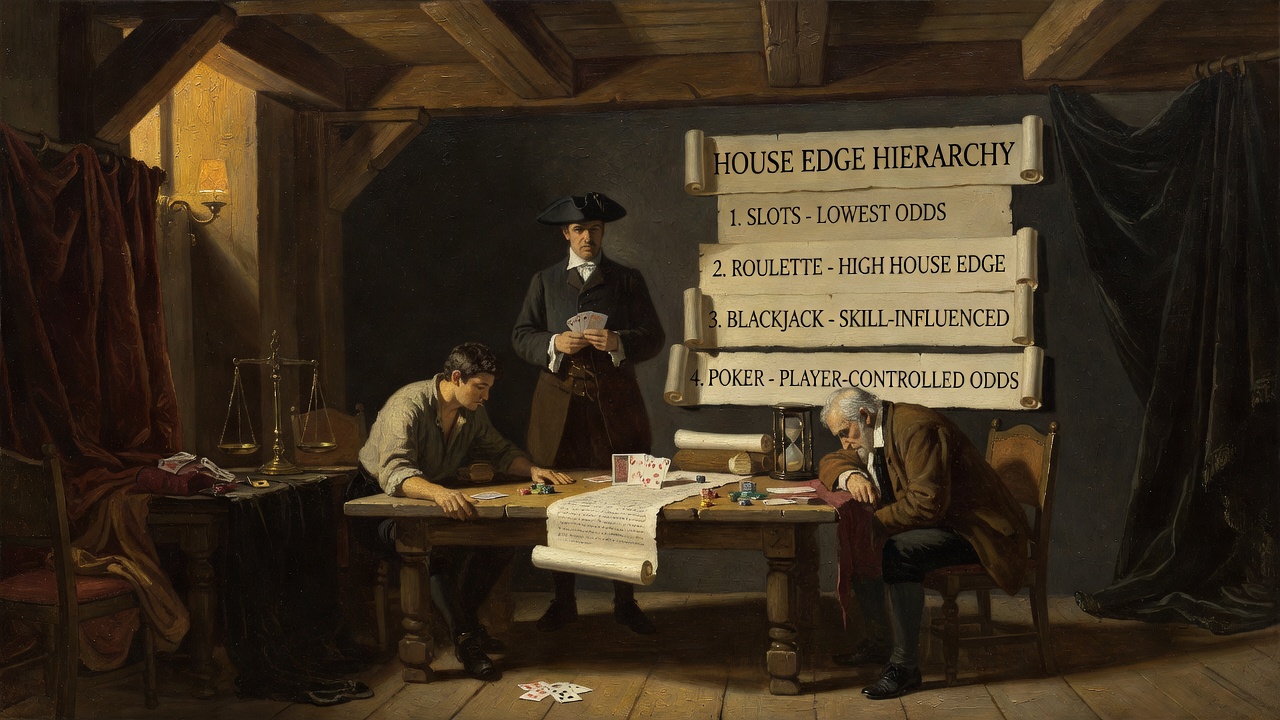
The House Edge Explained: Table Games Ranked by Player Odds
Privilege in casinos buys access to better odds. Understanding the hierarchy of house edges reveals the architecture beneath apparent equality.
The gentleman from Hamburg would arrive each spring. He wore linen suits. He ordered Perrier. He never discussed business. He sat at blackjack, then baccarat, then left.
I noticed something about the players who lasted longest in high-limit rooms. They weren't the richest. They were the ones who understood which games cost less.
The Hierarchy Observed
Blackjack treated players most generously. With proper strategy, the house edge approached one-half of one percent. Sometimes less. A Hamburg gentleman could lose eight dollars per thousand wagered. Sustainable. Predictable.
Baccarat presented a slightly steeper cost. Banker bets cost one percent. Player bets cost slightly more. But both remained manageable. The Hamburg gentleman would spend ten to fifteen dollars per thousand.
Roulette demanded different psychology. Twenty-seven dollars per thousand on European wheels. Fifty-three on American wheels. The cost was visible, unavoidable, irreversible.
What The Hierarchy Reveals
Table games have fixed house edges. These edges were not accidents. They were engineered. The engineers understood probability.
Blackjack allows player decision-making. Strategy reduces the house advantage. Roulette permits no decisions. The advantage remains fixed. This difference is not coincidence.
The Player Selection Effect
The gentleman from Hamburg chose blackjack deliberately. Not because he expected to win. But because the cost structure aligned with his preferences.
He could afford steady loss at a known rate. Eighty dollars per thousand seemed acceptable. Two thousand dollars per evening was affordable. Multiple evenings across multiple springs remained manageable.
Roulette would have destroyed his bankroll faster. The same capital would evaporate in shorter time. The gentleman understood this. He chose accordingly.
The Cost Comparison
Over one hundred hours of play at different games:
Blackjack: five hundred dollars expected loss Baccarat: seven hundred fifty dollars expected loss Roulette: Two thousand seven hundred dollars expected loss
These are not marginal differences. These are structural variations in cost per unit time.
The Information Asymmetry
Most players do not calculate this. They see the games as equivalent entertainment. The house edge is abstract. The experience is concrete.
The Hamburg gentleman calculated precisely. He understood that entertainment comes at a cost. The cost varied by game. He minimized cost for the experience he desired.
The Broader Insight
Casinos offer different games because different games serve different purposes. Roulette is designed for high-volume, low-intelligence play. Blackjack is designed for engaged players who understand strategy. Baccarat splits the difference.
The table game hierarchy is not hidden. The information is published. House edges are available to anyone with curiosity. Most players never consult this information.
The ones who do are the ones who last longest in casino environments. They understand that consciousness about costs determines sustainability.
The Final Observation
The Hamburg gentleman no longer visits. He stopped one spring and never returned. I never learned why. But his approach remained instructive.
He treated casinos as he would treat any service. Understand the pricing. Understand the value. Decide if the transaction makes sense. Proceed with that knowledge.
That is how you maintain status in a system designed to drain it. Not through luck. Through understanding.