Why Some Bonuses Are Restricted by Country
The casino sent an email that looked like good news. Free bonus spins on NetEnt's Gonzo's Quest, available in France, Germany, Spain, or the UK.
The casino sent an email that looked like good news. Free bonus spins on NetEnt's Gonzo's Quest, available in France, Germany, Spain, or the UK. Choose your country and claim 20 free spins, no deposit required.
Key Points
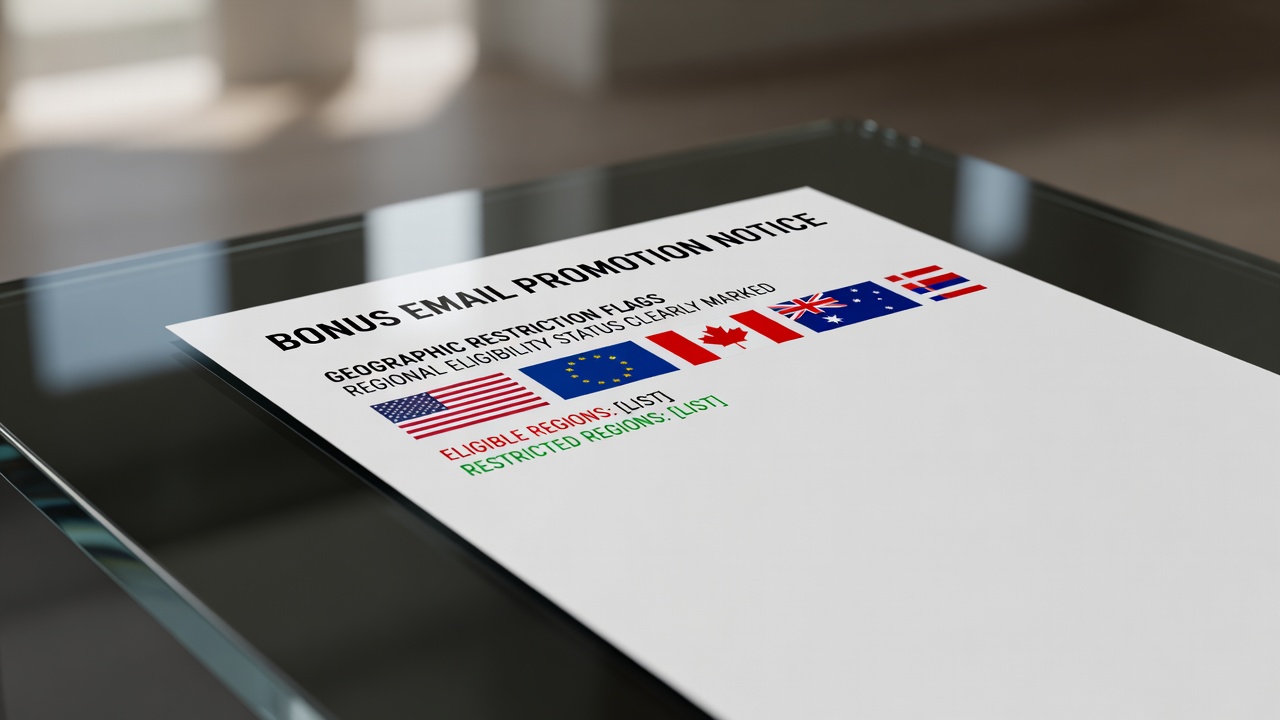
The catch was in the footer: This promotion is not available in your region.
Bonuses are not universal. A promotion that exists in the Netherlands might not exist in Italy. A deposit match available in Malta might be forbidden in Poland
his isn't random or arbitrary. It's the result of twenty-five years of regulators learning to read casino marketing.
The reason is re-deposit risk. When an operator offers free spins or free money in one jurisdiction, players in adjacent jurisdictions ask why they can't get the same deal. This creates pressure on national regulators. If Country A allows deposit-matching bonuses, players in Country B will migrate to operators licensed in Country A. Country B loses tax revenue. Country B's operators lose market share.
The second reason is the problem of bonus abuse. A bonus that looks good on its face becomes a liability after six months of play. A player claims they never authorized a wagering requirement. Another claims they can't withdraw after the bonus expires. A third disputes the terms retroactively. Regulators in jurisdictions with strong consumer protection laws have learned to either ban or heavily restrict the marketing of bonuses.
The third reason is that some countries have decided, as a matter of policy, that bonuses are a form of misleading advertising. If a thousand-dollar bonus comes with a 40x wagering requirement, you are not gaining one thousand dollars in value. You are gaining access to a one-thousand-dollar loan that you must repay by betting forty thousand dollars.
From an operator's perspective, managing regional bonus restrictions is a calibration task. An operator might offer a deposit match in the UK, a fixed free spins bonus in France, and nothing in Germany because German law forbids the structure they've chosen. This requires separate marketing tracks for each market. It requires training customer service reps to explain why a player in Austria can't get the same bonus as a player in Czech Republic.
The most practical implication: if you play from multiple countries or you move countries frequently, the bonuses available to you will change. A welcome offer valid in Italy is not valid in Greece. A promotion that worked last month might be deleted this month because a regulator issued new guidance.
The takeaway is straightforward. Bonuses are licensed, same as casinos. They are not gifts. They are not universal. They exist inside the legal framework of specific jurisdictions, and that framework is designed to protect players from the exact marketing tools the bonuses use. The underlying principle is that exploitation works when your opponents are not playing optimally. Most of your competition is not optimal. They are human. They are tired. They are emotional. They are making mistakes. The strategy that works against mistakes is the strategy you should play. Not the strategy that works against perfect play. Not the strategy that works in theory. The strategy that works against the actual people you're facing. The irony is that bonuses were supposed to increase player loyalty. Instead, they've become a tool that players use to find better deals. A player gets a bonus at one casino, plays it off, then immediately moves to another casino for another bonus. The player never has loyalty to any single casino. The casino spends money on bonuses to attract players who will never return.